
1:1 Mentorship + Placement Support

Master DSA + System Design. Learn how to get interview calls. Then train to clear interviews.

A structured program with recordings + weekly guidance + tests + mocks. Placement support starts once you hit clear readiness milestones (so efforts don’t go to waste).

Highest package in our alumni network: ₹58 LPA
681+ learners got offers in 2025
826+ offers secured in the last 12 months
Average offer package: ₹15 LPA

The CS FOR ALL Training System

A weekly rhythm that keeps you moving: learn → practice → test → review → improve → apply.

Career Training

You don’t “watch content”. You follow a weekly plan — and your preparation becomes predictable. until you’re ready.

Built for busy schedules Designed for real interviews
Pillar 01

Weekly plan (clear next steps)

Every week comes with a simple checklist: what to learn, what to solve, what to submit — and what to fix next.

Time-boxed paths for students and working professionals

No confusion — you always know the next step

Pillar 02

Practice engine (DSA problem sets)

Curated problem sets that build speed and patterns — the kind interviewers actually test.

Difficulty increases gradually (foundation → interview level)

Revision loops so patterns stay with you

Pillar 03

Weekly evaluation (tests + checkpoints)

You’re evaluated regularly, so you don’t discover gaps late. You see what’s missing early — and fix it while it’s easy.

Timed tests for DSA + design checkpoints

Mock interview cycles with structured feedback

Pillar 04

Feedback loops (review + corrections)

You don’t just “practice more”. You practice smarter — with corrections that show you exactly what to improve.

Mentor review + clear improvement notes

Redo → improve → validate (like real training)

Pillar 05

Readiness score (so support is focused)

We track preparation milestones so your placement support starts when you’re actually interview-ready — and every session has impact.

A simple milestone checklist (recordings + assessments + mocks)

When you hit it, 1:1 placement support begins

Pillar 06

Interview pipeline (shortlist → interview → offer)

We teach the full job-search workflow: shortlist roles, tailor your profile, apply smartly, prepare for loops, and handle offers confidently.

Interview-call strategy is taught from Week 1 (you can apply it anytime)

Resume + mock + interview loop prep after readiness

The Program Model (Two Routes)

You don’t have to wait months to start. From Week 1, we teach smart shortlisting + applications — while your interview prep runs in parallel.

Route 1 (Starts Week 1)

Getting Interview Calls

Learn the practical job-search playbook — how to position your profile, apply with intent, and start getting callbacks while you’re still preparing.

  • Resume + LinkedIn setup (role-wise)

  • Application strategy (tailoring, volume, targeting)

  • Live walkthroughs for 10–15 roles

  • So you can apply independently with confidence

Key idea: We don’t “apply for you”. We teach you a repeatable process — so you can consistently generate interview calls on your own.
Route 2 (Runs in parallel)

Clearing Interviews

Structured preparation for DSA + System Design + interview communication — so once you get calls, you can convert them into offers.

  • DSA (foundations → patterns → timed practice)

  • System Design (LLD + HLD, interview frameworks)

  • Hiring manager round + negotiation basics

Placement support starts after readiness: once you complete the learning + practice milestones, you unlock 1:1 guidance for resume tailoring, mock loops, and interview strategy.

Journey Timeline

Clear, structured steps — so you always know what’s next, and when full 1:1 placement support begins.

1

Onboarding + baseline

We understand your current level, goals, and timeline — then we set a clean weekly plan so you don’t feel lost.

Week 0
2

Training begins

DSA + System Design starts immediately. Alongside that, we teach the interview-call playbook from Week 1 — so you can start applying smarter while you prepare.

Week 1+
3

Assessments + mock practice

Timed tests, assignments, and mock rounds help you build speed + clarity — and show you exactly what to improve next.

Ongoing
4

Readiness milestone

Once you’ve completed the learning + practice milestones (recordings + assessments + mocks), you’re ready to move into the placement support track.

Milestone
5

Full 1:1 placement support begins

Now we go role-by-role: resume tailoring, interview-loop mocks, strategy for real openings, and guidance through the process.

Post-milestone

What a Week Looks Like

A clear weekly rhythm you can plan around — so you keep moving without burning out. Pick your cohort, follow the plan, and you’ll see steady progress.

Time commitment

Small steps, every week

Working Professionals

7–10 hrs/week

Built for job-switchers. A clean routine around work — videos + practice + one test — and you’re done for the week.

Final / Pre-final Year

10–14 hrs/week

Best for internship + entry-level prep. More practice + more mocks = faster confidence in interviews.

2028 / 2029 (1st/2nd Year)

6–8 hrs/week

Foundation track. Build habits early, strengthen basics, and start creating a strong internship runway.

Note

If you miss a week, don’t worry — just continue from the next checklist. The plan is designed to be restart-friendly..

Keep showing up. The results follow.

Sample Weekly Plan

Weekly rhythm

3 hrs recorded

DSA + System Design lessons in short modules, with clear notes and checkpoints.

4 hrs practice

Pattern-based problem sets + revision loop. You’ll feel speed and accuracy improve week by week.

1 assessment

A timed test or assignment to track progress — and highlight exactly what to fix next.

1 doubt / review session

Bring stuck questions, get corrections, and re-attempt with the right approach.

Optional contest (for practice)

Use it like training — not pressure. Even one contest a week builds calm under time.Steady practice wins.

Result

Every week ends with one simple question — what improved this week?

Learn → practice → test → improve

Interview Calls Playbook (Week 1)

You start learning the shortlisting + application process from the first week — while your DSA/System Design preparation runs in parallel.

Playbook Preview

Built for smart applications — targeted, role-fit, and repeatable.

Resume

Resume structure (the clean format recruiters skim)

We’ll help you build a crisp, role-fit resume — the kind that looks credible in 15 seconds and invites a shortlist.

What to keep, what to remove (with examples)

Impact bullets in a simple format (so it doesn’t sound fake)

LinkedIn

LinkedIn checklist (make your profile look “hireable”)

We turn your LinkedIn into a clean recruiter-facing page — clear role positioning, keywords, proof, and a strong first impression.

Headline + About (role-fit positioning)

Experience bullets aligned to common JDs

Applying

Job application strategy

You’ll learn how to choose the right roles and tailor quickly — so you apply more, without spending hours per job.

Shortlist rules (role, stack, level, location)

A fast tailoring method you can repeat daily

Pipeline

Track calls → rounds → offers (simple weekly routine)

A lightweight workflow to track applications, follow-ups, interview loops, and preparation focus — week by week.

Follow-up cadence that feels professional

Prep focus based on your upcoming rounds

Readiness first (for best results)

1:1 Placement Support Unlock

We start teaching the interview-call playbook from Week 1 — so you can begin applying smarter right away. Full 1:1 placement support starts once you complete the readiness milestones, so every resume edit, mock, and referral effort is focused and high-impact.

Why this exists: When you become interview-ready, the whole process becomes easier — calls convert better, mock feedback is sharper, and you don’t burn time applying blindly.

What You Get After Unlock

Once you hit the readiness milestone, you unlock full 1:1 placement support — aligned to the real interview loops you’re entering.

1:1 resume tailoring (role-by-role)

Quick, role-wise resume edits so your profile matches the job you’re applying for — without rewriting everything from scratch.

Referral support (when it genuinely helps)

Referrals aren’t the whole game — but when they add real leverage, we help you use them the right way.

Mock interviews for real interview loops

Mocks aligned to the rounds you’re facing (DSA / Design / HM). You get clear feedback — what to improve, and how to fix it fast.

Hiring manager + negotiation guidance

Guidance for HM rounds, decision-style questions, and negotiation basics — so you communicate clearly and close confidently.

How Referrals Work

Referrals are sensitive — so we handle them professionally and responsibly. That keeps your profile respected and the ecosystem strong.

Referral approach

Referrals are a boost — used thoughtfully.

We focus on building your profile and interview readiness first. When a referral genuinely strengthens your application for a specific role, we use it — cleanly and professionally.

We use referrals where they add real leverage. Not as a default step — but as a smart boost for the right role.

Referrals come after readiness milestones. So your resume, positioning, and interview prep are already strong.

We keep the ecosystem healthy long-term. Because a trusted referral is valuable — and we want it to stay valuable for you.

Referrals depend on

Context-based

Role fit

Your experience + stack aligns with the role level and scope.

Market timing

Open headcount, hiring cycles, and team priorities.

Resume strength

Clarity, role-fit positioning, and clean impact bullets.

Interview readiness

Confidence in DSA + System Design for the loop you’re entering.

What we do guarantee

Always

A clean system: preparation + weekly evaluation + feedback + guidance. Referrals are optional leverage. The foundation is your skill — and that’s what we build properly.

If the role level is a step higher than your current scope, we’ll first strengthen your positioning — so your application lands confidently.

If hiring is slow in a company or role, we focus on a smarter target list and stronger tailoring — so you still keep momentum.

If your readiness milestones aren’t completed yet, we focus on finishing them first — so referral support, when used, has maximum impact.

Mock Interview Engine

Real interview simulations with scoring, feedback, and a clear next plan — this is where practice turns into confidence.

Mock types

Three interview formats — one clear feedback system.

Mocks act like checkpoints — so you know what’s improving, and what to fix next before real interviews.

DSA mock

Timed problem-solving with real interview expectations — approach, clarity, and correct code.

45–60 min

System design mock

HLD/LLD discussion with trade-offs, structure, and communication — exactly like interview loops.

45–60 min

Hiring manager round

Role-fit + decision-making questions — how you explain ownership, impact, and thinking.

30–45 min

Scoring rubric

We score the things interviewers look for.

So feedback feels specific and useful — not vague.

Communication

Approach

Correctness

Trade-offs

Clarity

Output you receive

Actionable

A feedback note: what’s working, what needs improvement, and why.

A focus list: the exact patterns/concepts to fix first (so you don’t waste time).

A next-week plan: exactly what to practice before your next mock or real interview.

Role Tracks

Pick your target role. We’ll show what to focus on in DSA, what matters in System Design, and one project idea that genuinely strengthens your resume.

Backend Track

Best for backend-heavy roles. Strong DSA + clear System Design fundamentals go a long way in most product interviews.

DSA relevance

Very High

  • Core patterns: hashing, trees/graphs, recursion, DP (interview-style)
  • Speed + correctness + clear explanation (like a real round)

System design relevance

High

  • Caching, queues, DB design, scaling trade-offs
  • LLD clarity for common backend interview problems

Project suggestion

Queue-based Notifications + Rate Limiter

  • Features: auth + RBAC, retries, idempotency, structured logging
  • Design: API + DB schema + cache + queue (end-to-end)
  • Impact: latency/throughput metrics + dashboards

Full Stack Track

For end-to-end roles. DSA clears rounds — and one strong project helps shortlisting a lot.

DSA relevance

High

  • Core patterns + timed practice (so you don’t freeze in rounds)
  • Clear communication while coding (approach → steps → solution)

System design relevance

Medium–High

  • Service basics + caching + simple scaling
  • LLD for clean APIs and components

Project suggestion

Role-based Dashboard + API + Cache

  • End-to-end: UI → API → DB (clean flows + error handling)
  • Scale element: caching / queue (choose one and implement properly)
  • Impact: performance + monitoring + simple analytics

DevOps Track

For reliability / platform roles. System Design matters a lot. DSA is supportive but still useful in interviews.

DSA relevance

Medium

  • Interview basics: arrays/strings, hashing, simple graphs (practical level)
  • Scripting logic + reasoning under time

System design relevance

High

  • Reliability trade-offs: failure modes, scaling, incident thinking
  • Queues, retries, observability, SLO mindset

Project suggestion

CI/CD + Observability (Logs / Metrics / Traces)

  • Pipeline: build → test → deploy → rollback (a real flow)
  • Dashboards: logs + metrics + traces (one service, done well)
  • Impact: uptime mindset + incident playbook basics

SDE Track

Classic product SDE interviews: DSA + System Design are the main focus areas.

DSA relevance

Very High

  • Medium → medium-hard patterns (the real interview mix)
  • Speed + correctness + clarity (communicate while you code)

System design relevance

High

  • Common HLD systems + trade-offs (what to choose and why)
  • LLD interview problems (classes, APIs, edge cases)

Project suggestion

Mini Production System (Cache + Queue + DB)

  • Features: auth + RBAC + audit logs (real-world features)
  • Design: APIs + schema + caching + background workers
  • Story: bottlenecks → fixes → measurable improvements

Intern Track

Shortlisting = fundamentals + portfolio clarity. Build strong basics and one deep project you can explain confidently.

DSA relevance

High

  • Foundations + core patterns (interview-ready basics)
  • Timed practice + weekly tests (build calm under time)

System design relevance

Basics

  • Basic system thinking: APIs, DB, caching awareness
  • Simple trade-offs (what you chose and why)

Project suggestion

1 Deep Project (Not clones)

  • Depth: pick one theme and go deep (not 5 shallow projects)
  • Docs: clean README + architecture diagram + decisions explained
  • Demo: explain what / why / how in 2–3 minutes

Curriculum & Evaluation Plan

Everything is in one place — curriculum, practice sets, tests, mock interviews, and a clear weekly plan. Simple to follow, deep when you need it.

Explore by track

Not a playlist — a structured plan you can actually finish.

DSA Curriculum (In-depth)

Built for real interviews: patterns, speed, and clear thinking — taught in a way working professionals and students can both follow.

Core track

Foundations

  • Big-O, time/space analysis

  • Arrays, strings, two pointers

  • Hashing, prefix sums

  • Sorting + binary search

Premium standard: We’re not chasing contests here. We’re training for interviews — efficiently, with the right patterns and the right practice.

Practice standard

  • Questions are interview-style (LeetCode-level), plus a few selected Codeforces/CodeChef patterns for speed and thinking

  • Week 1–3: easy → medium (build confidence + fundamentals)

  • Week 4–8: medium → medium-hard (main interview zone)

  • Advanced: only if you’re targeting high-bar companies (optional)

Core interview patterns

  • Sliding window

  • Stacks/queues, monotonic stack

  • Linked list patterns

  • Recursion + backtracking

  • Greedy patterns

  • Bit manipulation basics

Trees, graphs & DP

  • Tree traversals, BST patterns

  • Heaps / priority queue

  • Graphs BFS/DFS, shortest paths (basic), topo sort, DSU basics

  • Interview DP patterns: 1D/2D patterns, knapsack, subsequence/substring, essential optimizations

Try Before You Commit

Watch two short previews to get a feel for our teaching style — how we think, how we explain, and what an interview-ready answer looks like.

Demo 1

DSA Demo

See how we solve an interview problem end-to-end — with a clean approach, correct code, and the kind of explanation interviewers look for.

Thought process — how we clarify the question, pick the right pattern, and plan before writing code.

Edge cases + complexity — time/space trade-offs, constraints, and why one approach beats another.

Interview-style explanation — structured, crisp, and confident (not just “here’s the code”).

Demo 2

System Design Demo

See how we structure a design interview — from requirements to trade-offs — so your answer feels clear and professional.

Requirements → clarify scope, constraints, and success criteria.

API → endpoints, request/response, pagination, and key flows.

Data → schema intuition, indexes, and data flow.

Scaling → caching/queues/sharding basics (only where needed).

Trade-offs → bottlenecks, reliability, and what you’d improve next.

Meet the Mentors

You’ll learn from mentors who’ve seen real interviews up close — and teach you how to prepare with clarity, consistency, and confidence.

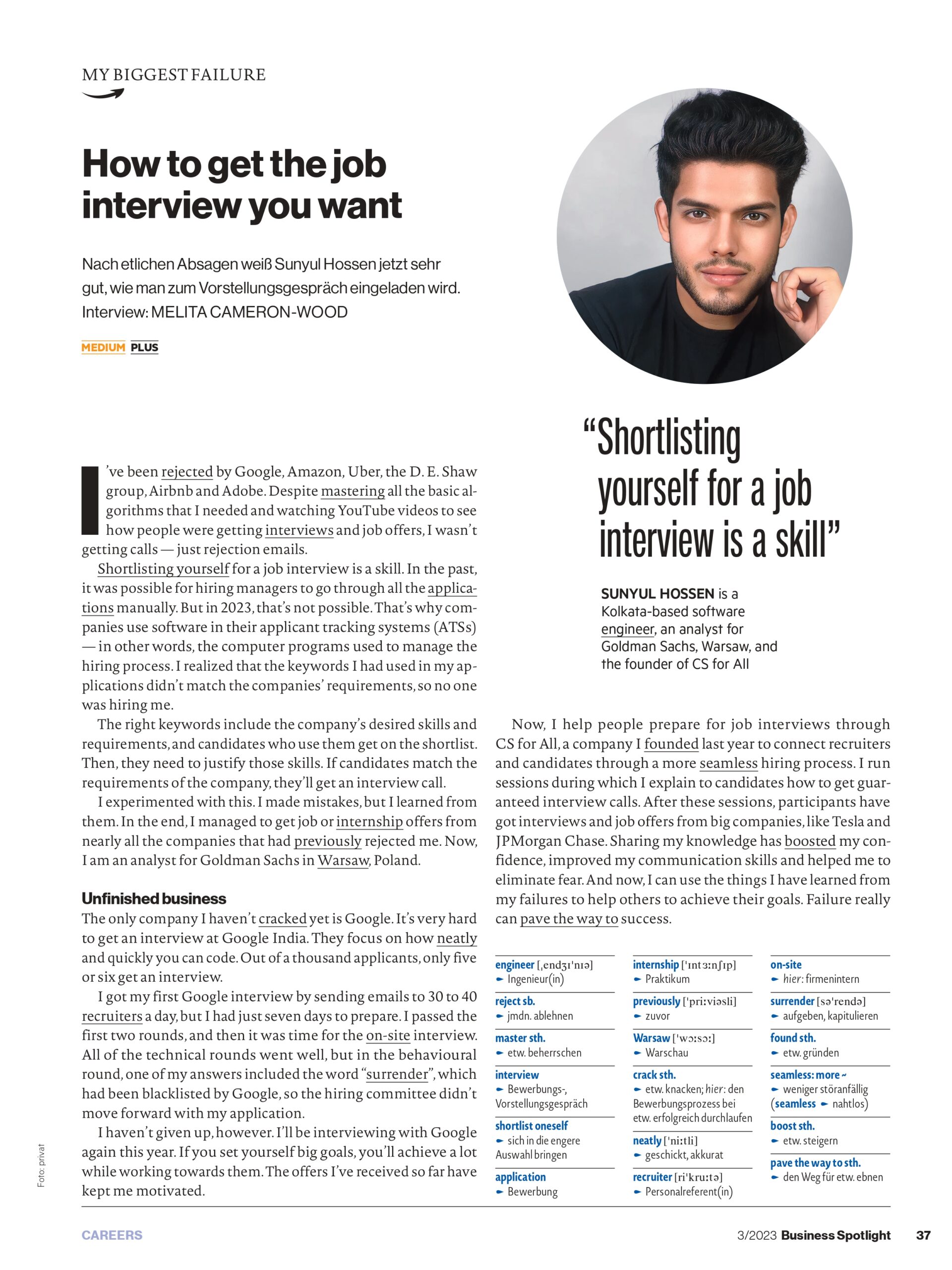
Sunyul Hossen
Core mentor DSA Interview Calls

Sunyul Hossen

Ex-Goldman Sachs Warsaw, Adobe, AmEx — DSA + Interview Calls Strategy

  • Interview-call playbook from Week 1 — resume structure, LinkedIn polish, and how to apply role-wise (not blindly).

  • DSA done the right way — pattern-first learning so you improve steadily (not random problem hopping).

Focus: a clear weekly routine — so you always know what to do next and you keep moving forward.
Isha Mehta
Google DSA

Isha Mehta

SWE-II (Google) — DSA

  • Interview-grade problem solving — build accuracy and speed with the patterns that show up most.

  • Explain while you solve — clean reasoning + structured approach (the style interviewers trust).

Focus: strong fundamentals + consistent practice — the kind that holds up on interview day.
Swagato Mondal
Uber System Design

Swagato Mondal

Senio SWE (Uber) — System Design

  • LLD + HLD, interview-style — requirements → design → trade-offs → scaling (in a crisp structure).

  • Case studies + communication — how to drive the conversation like a strong candidate.

Focus: structured thinking — so system design feels manageable, not intimidating.

Mentor philosophy

We keep things simple: learn step-by-step, practice weekly, and get feedback that tells you exactly what to improve. Once your fundamentals are strong, we help you prepare for real interview loops with 1:1 guidance.

Learn → Practice → Get Guided

Alumni Wall

People who trained with CS FOR ALL and are now working as software engineers across product companies.

Subhadip De
Verified Alumni

Subhadip De

SSE • Top Fintech Company

Shivansh Yashasvi
Verified Alumni

Shivansh Yashasvi

SDE • Amazon

Ishita Srivastava
Verified Alumni

Ishita Srivastava

SDE • Microsoft

Rounak Goswami
Verified Alumni

Rounak Goswami

SDE • Top Fintech Company

Abhinay Reddy
Verified Alumni

Abhinay Reddy

SDE • Valuefy

Yash Choudhary
Verified Alumni

Yash Choudhary

SDE • PhonePe

Fahad Ali
Verified Alumni

Fahad Ali

SDE 2 • Amazon

Abhishek Dixit
Verified Alumni

Abhishek Dixit

SMTS • Oracle

Ananya Choudhary
Verified Alumni

Ananya Choudhary

SWE • Visa

Shivani Panwar
Verified Alumni

Shivani Panwar

Offer • ZScaler

Sindhu Juloori
Verified Alumni

Sindhu Juloori

Data Scientist • PayPal

Ramandep Kaur
Verified Alumni

Ramandep Kaur

SWE • Flipkart

Astha Tripathi
Verified Alumni

Astha Tripathi

SRE • Zeta

Laavanaya Dhawan
Verified Alumni

Laavanaya Dhawan

SWE • Texas Instruments

Dushyant Raja
Verified Alumni

Dushyant Raja

SWE • Amazon

Harsha R
Verified Alumni

Harsha R

SWE • JP Morgan Scotland

Where alumni work

(highlights from this group)

Amazon Microsoft Visa PayPal Flipkart Zeta Texas Instruments JP Morgan Scotland PhonePe Oracle Valuefy Top Fintech ZScaler

Alumni Podcasts (Real Journeys)

Watch how our alumni actually prepared — what worked, what didn’t, and the exact decisions that changed their outcomes.

4 featured episodes

Not “motivational talks” — practical preparation stories you can copy.

Ishita Srivastava podcast thumbnail

Ishita Srivastava

SWE @ Microsoft • Offers from PayPal & Goldman Sachs

Off-Campus 50LPA+
Watch on YouTube →
Shivansh Yashasvi podcast thumbnail

Shivansh Yashasvi

SWE @ Amazon • Offers from ION Trading & TVS

Off-Campus 45LPA+
Watch on YouTube →
Harshaa Reddy G podcast thumbnail

Harshaa Reddy G

SWE @ JP Morgan (Scotland - United Kingdom)

Off-Campus International
Watch on YouTube →
Abhinay Reddy podcast thumbnail

Abhinay Reddy

SWE @ Valuefy • Offers from Knolskape & Stackpro

Off-Campus 15 LPA+
Watch on YouTube →

Outcomes You Can Expect

If you follow the weekly plan, you’ll start noticing very specific improvements — in problem-solving, system design thinking, and how you approach interviews end-to-end.

Outcome 1

Interview call momentum

You’ll learn how to present your profile clearly — resume + LinkedIn + role-wise applications — so getting calls becomes a skill you can repeat.

Outcome 2

DSA that holds up in interviews

Better accuracy and speed on the patterns that appear most — plus cleaner explanations while you code.

Outcome 3

System Design clarity (LLD + HLD)

A simple structure for design rounds: requirements → components → trade-offs → scaling — so you don’t get lost mid-way.

Outcome 4

Stronger final-round confidence

More structured answers in HM rounds, better communication, and calmer performance — because you’ve practiced with feedback and mock loops.

Outcome 5

A job-switch routine you can reuse

A clean weekly workflow: shortlist → tailor → apply → track → improve — so effort doesn’t feel random or wasted.

Small note: Everyone’s starting point is different — but the process is the same. If you stay consistent, you’ll build real interview readiness (and not just “watch content”).

Coding Contests & Weekly Challenges

Short, timed practice that builds speed, calmness, and clean thinking — so you’re ready for the pressure of real interviews.

Performance conditioning

Practice like it’s interview day.

Timed sets train you to think clearly under pressure — not just solve problems slowly. Over a few weeks, you’ll feel the difference in speed, structure, and confidence.

Weekly timed challenges (DSA)

Compact sets focused on the patterns we’re currently teaching — so recall becomes automatic and execution becomes clean.

Weekly

Monthly “Interview Simulation Test”

A real interview-style round: solve + explain your approach. We look at correctness, clarity, and how you communicate while coding.

Monthly

Post-test next plan

After every test, you get a simple next step: which patterns you missed and exactly what to practice next.

Always

Rewards & recognition

Healthy competition. Real benefits.

Top performers get practical advantages inside the program — the kind that actually helps you prepare faster.

Consistency badges — a clean signal of discipline and progress inside the cohort.

Priority mock slots — faster scheduling when you’re consistent and ready for mock loops.

Extra reviews — resume/portfolio feedback rounds unlocked for earned tiers.

Leaderboard (optional, for fun)

Show

A small, optional spotlight for the cohort — for people who enjoy friendly competition. Keep it hidden by default if you prefer a calm learning experience.

1

Top Performer of the Week

Tier A

2

Consistency Champion

Tier A

3

Fastest Improver

Tier B

Tools You’ll Use

We keep the tools simple on purpose. When everything is in one place, you stay consistent, move faster, and never feel lost.

Platform stack

Everything in one place — lessons, practice, tests, and support.

You focus on your weekly plan. We keep your recordings, problem sets, tests, mock slots, and feedback neatly organised.

Dashboard / LMS

Your weekly checklist, class recordings, notes, and progress — all visible in one clean dashboard.

Core

Test Portal

Weekly topic tests, timed DSA tests, and monthly interview simulations — so you know exactly where you stand.

Evaluation

Scheduling

Book office hours, doubt sessions, and mock interviews smoothly — with a fair slot system that keeps things predictable.

Mentorship

Community

Announcements, doubt threads, quick wins, and accountability — a focused community that keeps you moving every week.

Consistency

Resume Tracker

Track your target roles, resume versions, and application status — so your job search stays structured, not stressful.

Route 1

Mentorship Rhythm

This isn’t a helpdesk. It’s a learning program with real mentor touchpoints — so you always know what happens next.

Mentorship Standards

Clear response windows — so your momentum never breaks.

You’ll always know when to expect feedback, reviews, and mock updates. No guessing. No waiting blindly.

What you’ll get help on

When you’ll hear back

Doubts & quick clarifications (community threads)

24–48 hrs

Short, direct answers that unblock your practice — so you can continue the same day or next.

Test + assignment feedback

3–5 days

Clear review: what went right, what to fix, and exactly which practice set to do next.

Project review (optional track)

5–7 days

Architecture + code review + demo checklist — so your project feels like real engineering, not a college submission.

Mock slot planning

Eligibility + slots

Mocks are scheduled when you’re ready — so every mock feels meaningful and moves you forward.

Mock interview feedback

48–72 hrs

Actionable notes + score-style rubric + your next practice plan (what to do before the next round).

Need a quick nudge? If something is stuck (slots, reviews, or a missed response), just ping in the program channel — Program Ops will resolve it, and the Lead Mentor steps in when needed.

Readiness Score

A clean dashboard that keeps your prep on track. You always know what’s done, what’s next, and when your 1:1 placement support unlocks.

Dashboard preview (designed)

Clarity creates momentum.

This is how progress looks inside CS FOR ALL — simple, measurable, and easy to act on every week.

Readiness Scoreboard

Updated weekly Readiness tracking

Recordings completion

72%

Target for unlock: 90%

Assessment submission

61%

Target for unlock: 85%

Test performance trend

Improving

Last 4 tests: improving Accuracy + speed Weak patterns tracked
Result: your next practice set is generated from what you missed.

Mock interview status

2 completed

DSA mock: feedback shared SD mock: scheduled HM round: upcoming
Every mock comes with a feedback sheet + a clear next plan.

Resume readiness

48%

Status: structure ready, impact bullets in progress.

1:1 Placement Support

Once your readiness targets are completed, you unlock full 1:1 support — resume tailoring per job, mock loops aligned to your interviews, and referral help where possible.

Locked
Why it works

The gate feels fair — because it keeps you focused.

Most people don’t struggle because the syllabus is difficult. They struggle because progress feels invisible. Readiness Score makes progress visible — so you know exactly what to do next.

Clarity — you know your exact plan for this week.

Consistency — visible progress makes it easier to stay on track.

Readiness — 1:1 support starts when you’re genuinely prepared for real loops.

Mentor focus — time goes into the changes that move your outcome forward.

Unlock rule

Simple, clear, and easy to follow.

Recordings ≥ 90% + Assessments ≥ 85% + Mandatory mocks completed → 1:1 placement support unlocks.

1:1 Session Types

These sessions are where things get real — clear agenda, focused guidance, and next steps you can execute the same week.

Sessions breakdown
Post-unlock 1:1

1:1 Resume Review (per job)

We tailor your resume for one specific role — so your profile feels “built for this job”, not “sent everywhere”.

  • Role-fit edits: keywords, impact bullets, and the exact signals that role expects
  • Clean structure: recruiter-friendly layout that’s easy to scan in 10 seconds
  • Takeaway: the next resume version + what to apply to (and how) for that role
Post-unlock 1:1

1:1 Mock Interview Loops

We simulate the actual rounds you’re entering — so on interview day, it doesn’t feel new.

  • DSA Mock: problem solving + explanation + handling constraints clearly
  • System Design Mock: structured approach → APIs → data → scaling choices
  • Hiring Manager Mock: stories, decision-making, ownership, and offer conversation basics
Pre-unlock 1:1 / guided

1:1 Interview Call Strategy

From Day 1, you learn the job-hunt playbook — so calls start coming while you’re preparing.

  • Resume positioning: what recruiters actually look for (and what to remove)
  • LinkedIn clarity: headline, about, proof — so you look credible at a glance
  • Application playbook: targeting + fast tailoring + outreach that stays professional
Weekly Group

Group Office Hours (Weekly)

High-signal weekly sessions to clear blockers fast and keep your momentum strong.

  • Doubts: patterns, mistakes, and “where my approach breaks” fixes
  • Review: weekly plan check + test insights + what to do next
  • Momentum: accountability that keeps you consistent (even with a job)

How scheduling works: office hours happen every week. As you complete your readiness milestones, you unlock higher-focus 1:1 sessions (mocks + resume reviews). This keeps the process smooth, fair, and predictable for everyone.

Portfolio Track (Optional — Elite)

Built for 2028–2029 students and anyone who wants a stronger portfolio. You’ll build 1–2 high-quality projects with real engineering depth — architecture, tradeoffs, and clean execution.

Optional, high-bar track

Beyond a CRUD app — build like an engineer.

You’ll build 1–2 deep projects that feel production-style: clear architecture, smart tradeoffs, scale patterns, and clean code practices that interviewers respect.

System design + backend depth — caching, queues, DB design, and realistic workflows.

Real product features — auth, roles, logging, rate limits, background jobs, notifications.

Measurable improvements — latency wins, reliability upgrades, and simple performance metrics.

Interview leverage — a portfolio that gives you strong stories for hiring manager rounds.

For 2028–2029: Build strong fundamentals + a portfolio you’ll be proud to show — step by step, without rushing.

Project themes

Project directions that feel real (not generic)

  • Backend platform: queue-based workflows + retries + observability
  • High-scale feature: feed/notification/rate-limiter style system
  • Data-heavy: search/filtering + indexing + caching strategy
  • Production patterns: auth + RBAC + audit logs + metrics
Quality bar

Fewer projects — deeper execution

  • 1–2 projects (deep) — not 6 shallow clones
  • Clear architecture diagram + tradeoff justification
  • Deployment basics + environment config discipline
  • Readable codebase: modules, error handling, clean APIs
Review process

Mentor-style reviews (like a real team)

  • PR reviews — practical feedback on code + structure
  • Architecture review — design decisions + tradeoffs
  • Demo Day (optional) — showcase + storytelling practice
Cadence view

A weekly rhythm — so you always know what to do.

This is how a typical week runs inside CS FOR ALL: plan → practice → check → improve — repeated consistently so progress feels steady and measurable.

Day 1
Kickoff + baseline
60–90 mins · set your weekly target + quick benchmark to know your starting level
Start
Day 2
Office hours (doubts + guidance)
Get unstuck fast · clear doubts + align your approach for the week
Support
Day 3
Weekly topic test
30–45 mins · short test + pattern check (so you don’t guess progress)
Eval
Day 4
Office hours (review + fixes)
We break down mistakes · correct approach + improve explanation quality
Support
Day 5
Deep practice block
Focused DSA set + revision · this is where your speed and accuracy build
Work
Day 6
Mock slot day
45–60 mins · interview-style mock (DSA / System Design / HM round as per stage)
1:1
Day 7
Weekly reset
15–20 mins · review wins + lock next week’s plan (so momentum continues)
Reset
Cadence spec

What repeats every week

These blocks repeat like a system — so the program feels predictable, calm, and real (not “random learning”).

Onboarding
Day 1 (60–90 mins)
Office hours
2× / week
Test day
1× / week
Mock slots
Weekend priority

Note: Mock slots are planned around your current stage and upcoming interviews, so you get the right mock at the right time — not just “any mock.”

Editing tip

Quick customization

You can rename “Day 1 / Day 3 / Day 6” using your preferred days (Mon/Wed/Sat, etc.) — the layout stays the same.

How Mentorship Works

A structured support system — community + office hours + mock loops. You’ll always know where to ask, what to do next, and how feedback turns into improvement.

Format

Community-first, with structured sessions.

Most support happens inside the community — quick, clear, and documented so you can revisit it anytime. For deeper coaching: office hours + mock interviews.

Where it happens

Dedicated community channels for doubts, resources, announcements, and weekly progress check-ins. If a topic needs a full walkthrough, we take it to a call.

Always-on community

Office hours + doubt support

Fixed weekly slots for live doubt-solving and guidance. For async doubts, you get proper explanations — steps, clarity, and reasoning (not one-word replies).

Live + async

Mock interview process

You share your readiness snapshot → we schedule the right mock → you get an actionable feedback sheet → you return with a clear next plan. Mocks mirror real interview rounds.

Feedback loop

Success Definition (Your Target Job)

We set a clear target during onboarding so your prep stays focused, measurable, and stress-free.

Target

What “target job” means in this program

Not a vague dream — a simple target we agree on in onboarding, so your practice and applications stay aligned.

1) Role category

Required
  • Example: SDE-1 / SDE-2 / Backend / Frontend / Full-stack
  • For students: internship vs full-time (so the plan matches your timeline)

2) Minimum compensation band

Required
  • Set a minimum range (CTC / base — whichever you prefer)
  • We keep it aligned with your experience + current market

3) Location preference (optional)

Optional
  • Remote / Hybrid / Onsite (and preferred cities if any)
  • More flexibility = more openings — we’ll help you choose the trade-offs

4) Constraints & timeline

Required
  • Notice period, weekly availability, interviews you can take per week
  • Any non-negotiables (only remote / only Kolkata, etc.) — tell us upfront so we plan correctly

One clear target = sharper prep, better shortlisting, and faster decisions.

Onboarding alignment

Aligned in onboarding

We’ll look at your profile + the market, then lock a realistic target and a plan to reach it.

Realistic target rule

Alignment
  • Target matches your experience, current skills, and the role level
  • If we need to adjust, we do it early — so your effort always goes in the right direction

How we work together

Core
  • Complete readiness steps (recordings + assessments + mocks) so interviews feel familiar
  • Follow the weekly application + interview routine shared by mentors
  • Stay consistent — if life gets busy, just update us so we reschedule and keep momentum
Examples

Example (Professional)

“Backend SDE-1/SDE-2, minimum ₹X–₹Y CTC, Bengaluru/Hybrid, 2–3 interviews/week.”

Example (Final year)

“SDE-1 entry roles, minimum ₹X CTC, any metro city ok.”

Example (2028/2029)

“Internship-first pipeline: shortlist targets + readiness milestones + resume/portfolio plan.”

This clarity keeps your roadmap clean — what to learn, what to practice, and what to apply for, week by week.

Simple price. Premium experience.

Why the fee is ₹3,499

Programs with similar mentorship + placement support usually sit around ₹30K–₹40K+. We keep it at ₹3,499 because we’ve built a model that scales — without cutting corners.

The reason the price stays low is simple: our alumni keep the flywheel running.
When you get placed, you become part of the give-back circle and guide a few learners — so every new cohort gets premium support without premium pricing.
We don’t want this to feel like “just a course fee”.
We want it to feel like a real career program — with a system that continues even after you land the offer.

Outcome Guarantee

A simple outcome-backed promise for serious learners. This isn’t a “trial” product — it’s a structured mentorship program with a clear weekly plan. If you complete the learning milestones and follow the job-hunt plan we guide you through, and still don’t reach the goal you set at onboarding, you’re eligible for a full refund (as per the terms).

Outcome-backed promise

No hacks — just a guided system, with real accountability.

We’ve kept the program price intentionally accessible — and in return, we ask for consistent effort. Follow the readiness plan (learning + assessments + mocks) and the job-hunt playbook we track with you. If you do your part and still don’t hit your chosen target outcome, you can claim a 100% refund.

Note: Your fee is protected by this outcome promise when you complete the milestones.

FAQs

Clear answers — so you can join with confidence: how the readiness checklist works, when 1:1 support unlocks, and how referrals work in real life.

Cohort onboarding: Next batch - 3 Feb, 2026

If you’re serious about switching — follow a real system, not hype.

From Day 1, you’ll follow a clear weekly plan — DSA, System Design, and guided practice that builds momentum. Finish the readiness milestones, and you unlock full 1:1 placement support + mock interviews. You’ll feel calm because you always know what to do next.

What you get

DSA + System Design + interview practice + job-hunt playbook (dev optional)

Unlock condition

Readiness milestones → then 1:1 placement support

Best for

Working professionals + final years • 2028/2029 (foundation track)

This Month’s Cohort (So Far)

A few among all the learners who joined us this month.

12 highlights

Different backgrounds. Same goal: get interview-ready.

Cohort member role: Junior Engineer

Junior Engineer

Startup
Cohort member role: Associate Engineer

Associate Engineer

Startup
Cohort member role: Consultant

Consultant

BIG 4
Cohort member role: Assistant Engineer

Assistant Engineer

WITCH
Cohort member role: Freelancer

Freelancer

Independent
Cohort member role: 2026 Batch

2026 Batch

Student
Cohort member role: 2028 Batch

2028 Batch

Student
Cohort member role: Validation Engineer

Validation Engineer

Startup
Cohort member role: Specialist

Specialist

Government Bank
Cohort member role: Scientist

Scientist

WITCH
Cohort member role: Analyst

Analyst

MAANG
Cohort member role: Software Engineer

Software Engineer

WITCH
Scroll to Top